
This past May several MS students completed their projects and examinations. These are completed by talks at the Mastersday in natural sciences, which this year had many biology related projects.
First and foremost, Ruhila Goswami with her thesis on Evolutionary Divergence in Dental Variation and Sex Chromosome Architecture in Icelandic Brown Trout and Arctic Charr.
Cosupervisor was Guðbjörg Ósk Jónsdóttir. The abstract of Ruhilas thesis:
Evolutionary divergence stems from populations adapting to different niches, which
change phenotypic traits and underlying genes. Over generations, this results in
distinct forms and new species. Niche availability is often shaped by geological events
over long timescales. A relatively recent deglaciation event created new freshwater
habitats in the northern hemisphere, for example in Iceland. These were colonized by
cold-adapted, sea-run species, including Arctic charr (Salvelinus alpinus) and Brown
trout (Salmo trutta). The resulting populations underwent rapid diversification leading
to many morphs of Arctic charr, by colonizing different niches with different prey types.
This can affect dentition, which this dissertation focused on. The Vomer bone showed
the greatest differences in tooth numbers by species, the allometric relationships did
not vary much by groups, but dentition patterns correlated with divergence of charr
morphs.
The second part of the thesis focused on sex chromosome evolution in charr and trout.
The male sex determining gene (sdY) has a history of translocation in salmonids, to
avoid Y chromosome degeneration. Ecological opportunity may lead to phenotypic
diversification and changes in associated genes. Indirectly, this may lead to genomic
restructuring, possibly causing reproductive isolation that may involve sex linked
chromosomes. The sdY gene was mapped in Brown trout and did not vary by populations.
However, the results demonstrate higher heterogeneity in sdY location among
Arctic charr populations and sympatric morphs, consistent with earlier findings. This
could suggest sex chromosomes may correlate with diversification and speciation in
salmonids.
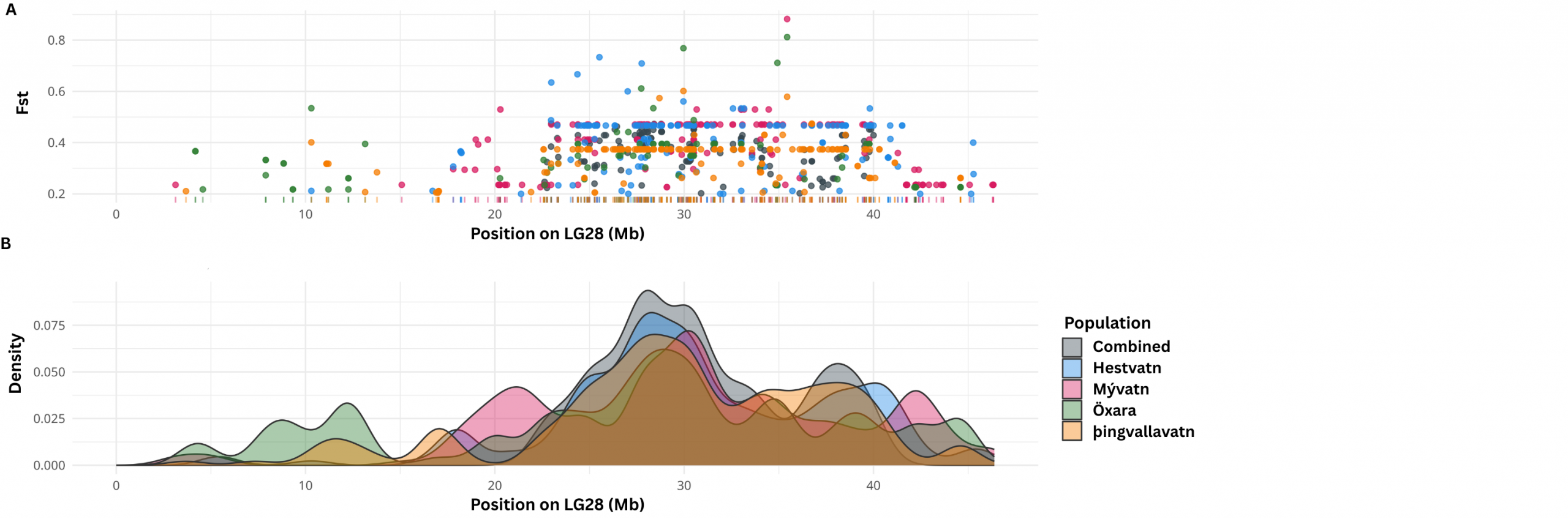
markers on chromosome
Other students that we cosupervised and also completed this spring were:
Björgvin Ægir Elisson - Can transcriptional enhancers mediate ibrutinib resistance in Waldenström Macroglobulinemia? (Main supervisor Erna Magnúsdóttir)
Sandra Dögg Georgsdóttir - Physiological and behavioural responses of the lugworm, Arenicola marina, to contaminated sediment: A potential bioindicator for pollution in Iceland (main supervisor Halldór P. Halldórsson)
Árni Valdason - The spread of self-seeded lodgepole pine (Pinus contorta DOUGLAS EX LOUDON) in South and West Iceland (main supervisor Pawel Wasowicz)