Marcos G. Lagunas had another chapter of his thesis published, in Ecology and Evolution. His Phd defense will be later this year.
, , , , and . 2026. “ Genetic Structure and Signs of Local Adaptation in Icelandic Brown Trout Populations.” Ecology and Evolution 16, no. 9: 74274. https://doi.org/10.1002/ece3.74274.
Abstract of paper
Loss of anadromy in Salmonids frequently follows postglacial colonization and habitat change, a process driven by selective pressures where benefits of residency outweigh migration costs. At the end of the last Ice Age ca. 10,000 years ago, anadromous brown trout arrived in Iceland and invaded newly formed habitats. Some populations became isolated in headwaters early after the ice retreated, presumably accelerating local adaptation and the evolution of residency. In this study, we assessed the genetic relatedness and diversity of brown trout on a countrywide scale to decipher the number of unique populations and their connectivity. We tested for gene flow from headwaters and assessed effects of isolation and adaptation. We genotyped 600 individuals from 40 locations using ddRADseq, identifying 2946 putative neutral SNPs. We identified 16 groups of genetically similar individuals (genetic clusters), five of which were primarily composed of anadromous individuals. On a large scale, the genetic variation and relatedness of trout populations reflect the geography of waterways while within watersheds the topography, for example, the presence of waterfalls and lakes, is key. Counterintuitively, downstream gene flow from isolated headwater populations was only seen in small river populations whereas gene flow from large lake populations appears negligible. Using outlier SNPs, we identified several hundred loci associated with temperature and habitat type (i.e., lake vs. river). Temperature-associated markers mapped to loci associated with immune response, lipid metabolism and transmembrane protein genes. Our results highlight the effects of isolation on genetic diversity in headwater populations and the importance of identifying unique populations in conservation efforts.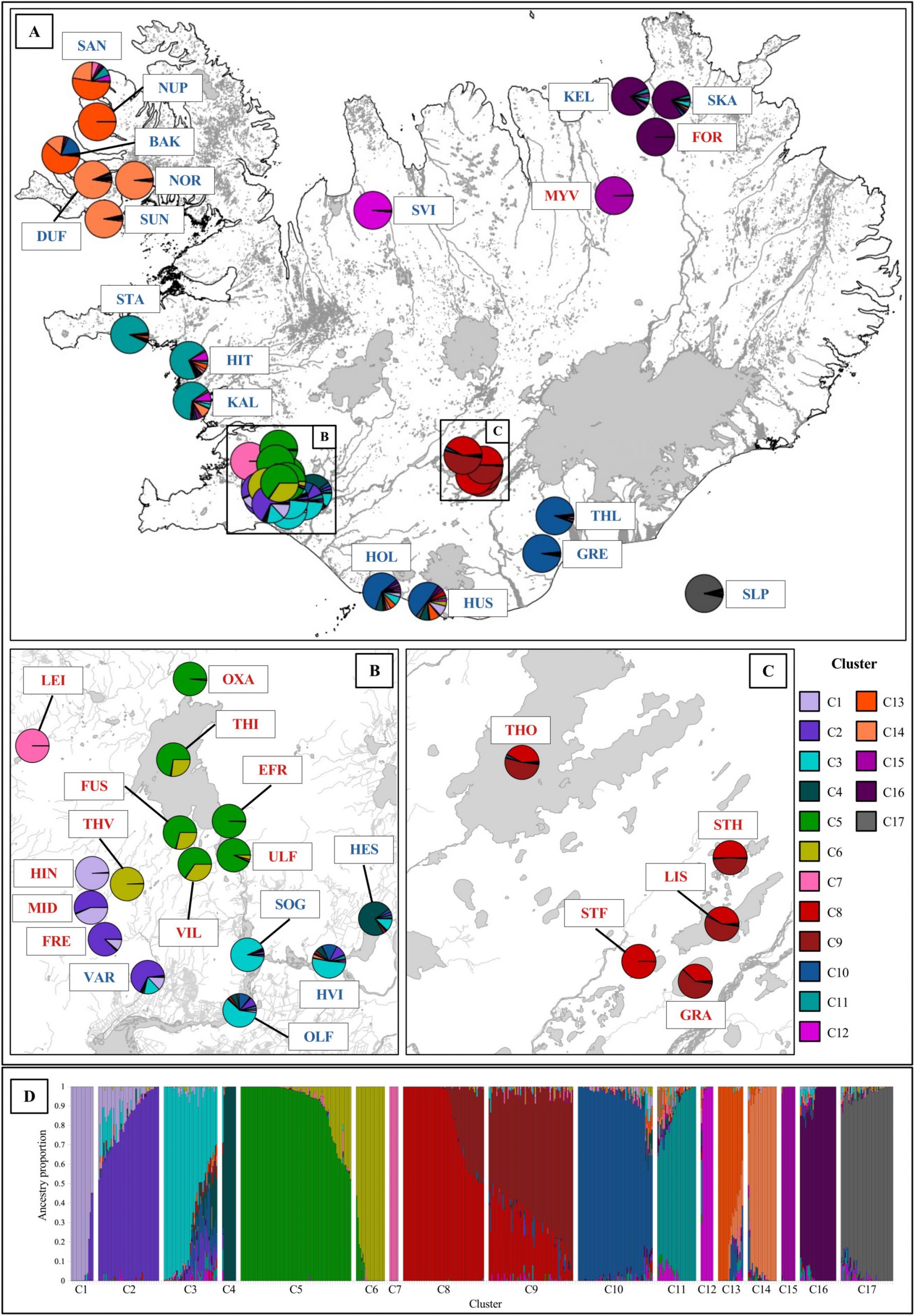
Figure 2 from paper. Legend: Clear genetic differentiation of brown trout in Iceland, with many distinct headwater populations and clear separation of anadromous fish by geography. (A) Map of Iceland with admixture pie plots using K = 17 ancestral populations. The names of headwater locations are indicated in red and those of locations with potential access to the ocean in blue. The pie for the Scottish reference group (SLP) is placed on graph for comparison. The two insets show the watersheds of River Ölfusá, Lake Þingvallavatn, Úlfljótsvatn and the Hengill mountain (B) and Veiðivötn and Þórisvatn (C). A reference to the three-letter code for each location can be found in Table S1. (D) Ancestry composition of each fish assuming K = 17 grouped by cluster. Note, each cluster is formed by individuals showing > 50% of the dominant genetic component (or at the highest proportion when < 50%). A version of this matrix showing individuals grouped by location is shown in Figure S8.