Genetic Structure and Signs of Local Adaptation in Icelandic Brown Trout Populations

Marcos G. Lagunas had another chapter of his thesis published, in Ecology and Evolution. His Phd defense will be later this year.

Lagunas, M., A. Pálsson, L. Jerman-Plesec, Z. O. Jónsson, and S. S. Snorrason. 2026. “ Genetic Structure and Signs of Local Adaptation in Icelandic Brown Trout Populations.” Ecology and Evolution 16, no. 9:  74274. https://doi.org/10.1002/ece3.74274.

Abstract of paper

Loss of anadromy in Salmonids frequently follows postglacial colonization and habitat change, a process driven by selective pressures where benefits of residency outweigh migration costs. At the end of the last Ice Age ca. 10,000 years ago, anadromous brown trout arrived in Iceland and invaded newly formed habitats. Some populations became isolated in headwaters early after the ice retreated, presumably accelerating local adaptation and the evolution of residency. In this study, we assessed the genetic relatedness and diversity of brown trout on a countrywide scale to decipher the number of unique populations and their connectivity. We tested for gene flow from headwaters and assessed effects of isolation and adaptation. We genotyped 600 individuals from 40 locations using ddRADseq, identifying 2946 putative neutral SNPs. We identified 16 groups of genetically similar individuals (genetic clusters), five of which were primarily composed of anadromous individuals. On a large scale, the genetic variation and relatedness of trout populations reflect the geography of waterways while within watersheds the topography, for example, the presence of waterfalls and lakes, is key. Counterintuitively, downstream gene flow from isolated headwater populations was only seen in small river populations whereas gene flow from large lake populations appears negligible. Using outlier SNPs, we identified several hundred loci associated with temperature and habitat type (i.e., lake vs. river). Temperature-associated markers mapped to loci associated with immune response, lipid metabolism and transmembrane protein genes. Our results highlight the effects of isolation on genetic diversity in headwater populations and the importance of identifying unique populations in conservation efforts.
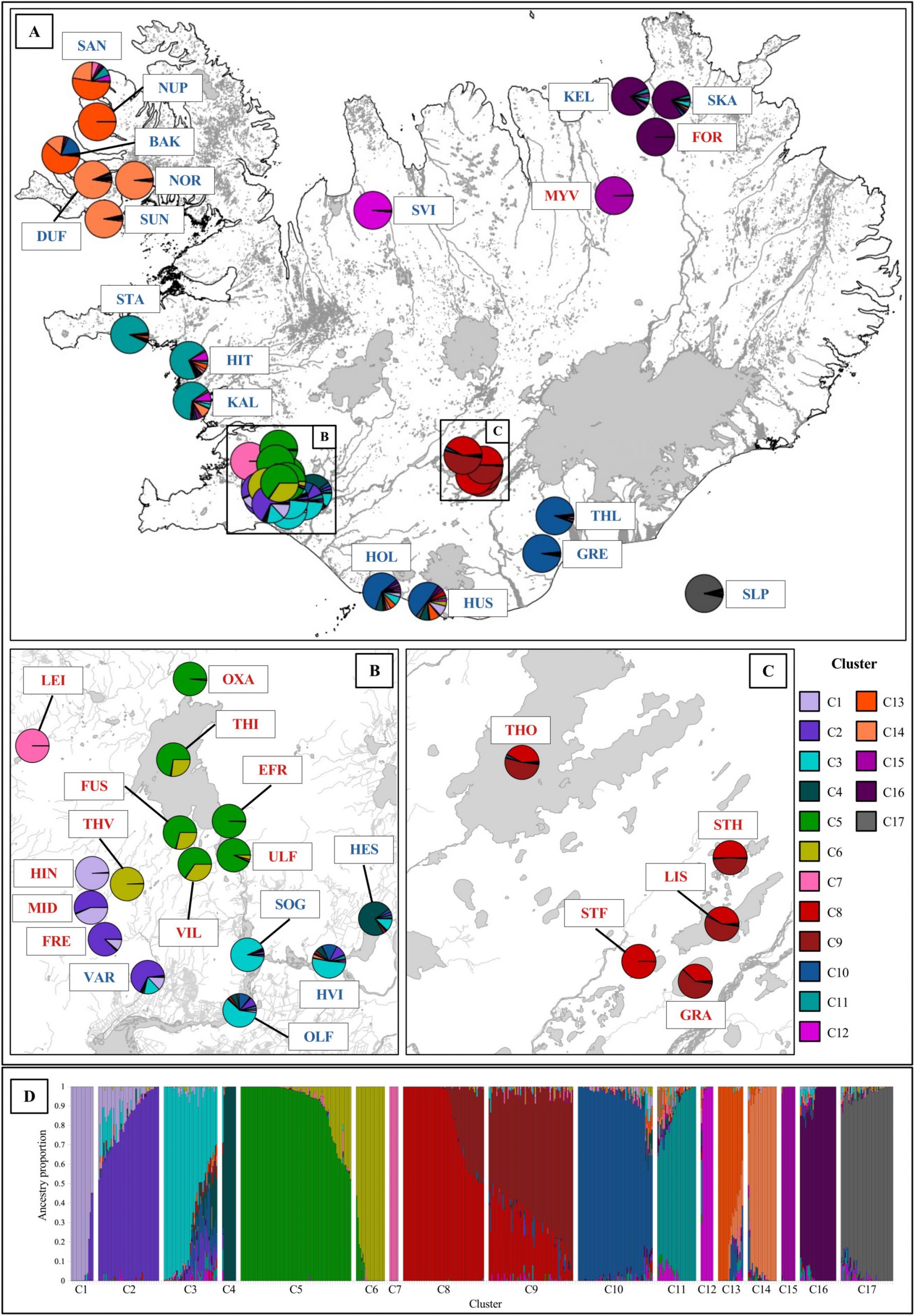
Figure 2 from paper. Legend: Clear genetic differentiation of brown trout in Iceland, with many distinct headwater populations and clear separation of anadromous fish by geography. (A) Map of Iceland with admixture pie plots using K = 17 ancestral populations. The names of headwater locations are indicated in red and those of locations with potential access to the ocean in blue. The pie for the Scottish reference group (SLP) is placed on graph for comparison. The two insets show the watersheds of River Ölfusá, Lake Þingvallavatn, Úlfljótsvatn and the Hengill mountain (B) and Veiðivötn and Þórisvatn (C). A reference to the three-letter code for each location can be found in Table S1. (D) Ancestry composition of each fish assuming K = 17 grouped by cluster. Note, each cluster is formed by individuals showing > 50% of the dominant genetic component (or at the highest proportion when < 50%). A version of this matrix showing individuals grouped by location is shown in Figure S8.
Posted in Graduate students, Publications

MS student galore

This past May several MS students completed their projects and examinations. These are completed by talks at the Mastersday in natural sciences, which this year had many biology related projects.

First and foremost, Ruhila Goswami with her thesis on Evolutionary Divergence in Dental Variation and Sex Chromosome Architecture in Icelandic Brown Trout and Arctic Charr.

Cosupervisor was Guðbjörg Ósk Jónsdóttir. The abstract of Ruhilas thesis:

Evolutionary divergence stems from populations adapting to different niches, which
change phenotypic traits and underlying genes. Over generations, this results in
distinct forms and new species. Niche availability is often shaped by geological events
over long timescales. A relatively recent deglaciation event created new freshwater
habitats in the northern hemisphere, for example in Iceland. These were colonized by
cold-adapted, sea-run species, including Arctic charr (Salvelinus alpinus) and Brown
trout (Salmo trutta). The resulting populations underwent rapid diversification leading
to many morphs of Arctic charr, by colonizing different niches with different prey types.
This can affect dentition, which this dissertation focused on. The Vomer bone showed
the greatest differences in tooth numbers by species, the allometric relationships did
not vary much by groups, but dentition patterns correlated with divergence of charr
morphs.
The second part of the thesis focused on sex chromosome evolution in charr and trout.
The male sex determining gene (sdY) has a history of translocation in salmonids, to
avoid Y chromosome degeneration. Ecological opportunity may lead to phenotypic
diversification and changes in associated genes. Indirectly, this may lead to genomic
restructuring, possibly causing reproductive isolation that may involve sex linked
chromosomes. The sdY gene was mapped in Brown trout and did not vary by populations.
However, the results demonstrate higher heterogeneity in sdY location among
Arctic charr populations and sympatric morphs, consistent with earlier findings. This
could suggest sex chromosomes may correlate with diversification and speciation in
salmonids.

markers on chromosome

Other students that we cosupervised and also completed this spring were:

Björgvin Ægir Elisson -  Can transcriptional enhancers mediate ibrutinib resistance in Waldenström Macroglobulinemia? (Main supervisor Erna Magnúsdóttir)

Sandra Dögg Georgsdóttir -  Physiological and behavioural responses of the lugworm, Arenicola marina, to contaminated sediment: A potential bioindicator for pollution in Iceland (main supervisor Halldór P. Halldórsson)

Árni Valdason - The spread of self-seeded lodgepole pine (Pinus contorta DOUGLAS EX LOUDON) in South and West Iceland (main supervisor Pawel Wasowicz)

Posted in Graduate students

(Icelandic) Uppástand, umhverfi – pistill fyrir Rás 1

Sorry, this entry is only available in Icelandic.

Posted in Articles about science

Participation in NoWPaS 2026

NoWPaS International Workshop of PhDs and Post-doctoral Fellows on Anadromous Salmonids was held in Holar University, Iceland early in March.

This is organized by students and postdocs, for them selves. Few seniors get to join, and share their work and discuss the projects with the young scientists.

Group in front of Holar church.

We participated, with four contributions.

Kenedy Annejulee Williams - talked about a summer project on the "Nursery grounds of Anadromous Arctic charr in Icelandic rivers: where to go when rivers warm?" - and won best talk in session price.

Arnar Pálsson - gave an overview of the work for past decade or so "The interplay of environment, genetics and history: the case of ecological divergence in Arctic charr."

Ruhila Goswami - talked about part of her MS thesis "Evolution of the Sex-Determining Gene sdY in Anadromous and Landlocked Arctic Charr and Brown Trout Populations from Iceland"

and Guðbjörg Ósk Jóndóttir - talked about her manuscript in preparation "Divergence of functional phenotypes in feeding elements of Arctic charr (Salvelinus alpinus) along the benthic – pelagic axis."

Posted in Talks and events

MS projects in aquatic biology

The new cohort in MS programme on Aquatic biology and fisheries can choose from a variety of projects.

The coordinator of the programme at the University of Iceland is Dr. Haseeb Randhawa. He maintains a list of projects that students can request to work on.

Here we list three projects that are also offered to students in this programme in the fall of 2026.

FILLED - Genetic diversity in the mitochondrial genome of Icelandic salmon  

This project has now been filled. Áki can be reached for work on related projects.

Prospective Masters students are invited to apply for a 90 ECT research project
at the School of Engineering and Natural Sciences at the University of Iceland.
The project is in collaboration with the Marine and Freshwater Research Institute and
the Biomedical Center at the University of Iceland, and is entitled
“Genetic diversity in the mitochondrial genome of Icelandic salmon”
The student will be tasked with isolating DNA from multiple contemporary and historical samples from the collections of the Marine and Freshwater Research Institute in order to sequence complete mitochondrial genomes from multiple individuals.

The central aim of the project will be to characterize the diversity within the mitochondrial genome of salmon collected across Iceland and possible shifts in genetic composition within select stocks.
Project supervisors are Áki Jarl Láruson, Katrín Halldórsdóttir, & Leó Alexander Guðmundsson. Academic advisor is Arnar Pálsson.

Applicants who would like to tackle this project should send a copy of their CV
and a brief introduction which higlights their interest in the project to
aki.jarl.laruson@hafogvatn.is

Ecological influence on evolution of feeding elements in sympatric morphs  

Ecological opportunities can be exploited by organisms and leading to evolutionary divergence and even speciation. Fish show an impressive diversity in feeding specializations, seeming resulting from evolution and ecological opportunities.  Data suggest substantial level of phenotypic parallelism in body- and head-shape in Arctic charr, when they radiate into diverse morphs in northern lakes. The research project centers on questions at the intersection of ecological, evolutionary and developmental biology or anatomy. The aim is to study morphological variation in sympatric charr to study the ecological influence on feeding morphology (teeth and bone shape). The over arching questions are: Which feeding traits differ consistently between sympatric morphs across lakes? Does plasticity in feeding traits differ between benthic and pelagic morphs? What is the pattern of evolutionary divergence in upper and lower jaw traits in Arctic charr?  The approach will be based on ecological sampling, dissections and morpological and statistical analyses including the use of geometric morphometrics. The student will work with other graduate students in the Arctic charr group at the University of Iceland, and scientsist at the Freshwater division of MFRI and at Universities in Canada. The candidate should have biology or ecology background, numerical skills a strong suit, and have interest in anatomical diversity, ecology, evolution and development.

maxilla, premaxilla, palatine, supramaxilla

Supervisors: Arnar Pálsson and Gudbjörg Ósk Jónsdóttir (https://orcid.org/0009-0008-0502-5553) at University of Iceland. 

Location: Field work in South-west Iceland and lab work in Reykjavík 

Examples of related studies. 

Jónsdóttir GÓ, von Elm L-M, Ingimarsson F, Tersigni S, Snorrason SS, Pálsson A, et al. (2024) Diversity in the internal functional feeding elements of sympatric morphs of Arctic charr (Salvelinus alpinus). PLoS ONE 19(5): e0300359. https://doi.org/10.1371/journal.pone.0300359  


Genomics of rapid diversification in craniofacial traits related to feeding 

The genetic raw material for adaptive evolution can now be studied with whole genome sequencing, and the patterns of positive selection detected in genomes of non-model organisms. Systems with extensive sympatric and allopatric polymorphism can be studied with these methods, to map out patterns of divergence and highlight loci and genomic regions that have been shaped by positive selection in response to ecological diversity. Arctic charr is known for considerable polymorphism and substantial phenotypic parallelism in feeding and body morphology. The aim of this project is to explored the genomics related to craniofacial diversity in sympatric Arctic charr, in reference to anadromous populations (putative ancestors). The research questions are the following: i) which loci and molecular pathways separate ecologically specialized morphs, ii) what is the role of structural variations in maintaining morph separation, and iii) when in development do adaptive traits emerge? The project involves sampling fish in their habitat, processing them and working with students doing phenotypic analyses. The main effort will be DNA isolation and analyses of whole genome sequencing data from the sampled populations, using bioinformatic and population genetic tools and programmes. The ideal candidate should have biology and genetics background, strong bioinformatic and numerical skills are required. 

Comparison of distributions of Heterozygosity by morphs and lakes

Supervision: Arnar Pálsson, Zophonías O. Jónsson and Gudbjörg Ósk Jónsdóttir at the University of Iceland. 

Location: Sampling in South-west Iceland, lab work and analyses in Reykjavík 

Examples of related studies. 

Han Xiao, Arnar Palsson, Zophonías Oddur Jónsson, et al. Gene flow and habitat heterogeneity shape coexistence dynamics of Arctic charr morphs in connected lakes. Authorea. December 27, 2024.
DOI: 10.22541/au.173531304.47377188/v1

Jónsdóttir GÓ, von Elm L-M, Ingimarsson F, Tersigni S, Snorrason SS, Pálsson A, et al. (2024) Diversity in the internal functional feeding elements of sympatric morphs of Arctic charr (Salvelinus alpinus). PLoS ONE 19(5): e0300359. https://doi.org/10.1371/journal.pone.0300359  

Posted in Graduate students, Uncategorized

(Icelandic) Öld gensins eftir Evelyn Fox Keller

Sorry, this entry is only available in Icelandic.

Posted in Articles about science, Publications Tagged |

Two new papers

Two manuscripts on Arctic charr were published in January. Guðbjörg Ósk Jónsdóttir, analyzed teeth variation in the sympatric morphs in Þingvallavatn, out in Evolutionary biology.

Jónsdóttir, G.Ó., Ingimarsson, F., Snorrason, S.S. et al. 2026 Variation of Tooth Traits in Ecologically Specialized and Sympatric Morphs. Evolutionary Biology. https://doi.org/10.1007/s11692-026-09665-2 

Following up on work by Finnur Ingimarsson she describes allometry of teeth numbers, and differences by bones and morphs. Influence of size and morph on number of teeth varied by bone. The scatterplots show individual tooth numbers (Y-axis) against size (ln(FL in cm) X-axis) for the four morphs and six bones; A dentary, B maxilla, C premaxilla, D palatine, E vomer and F glossohyal. Note the numbers for symmetric bones (A–D) are averages for the left and right bones. Each plot shows p values from glmmTMB for the effect of morph (M), body size (FL) and morph by body size (M × FL) on tooth number.

The other paper is by Han Xiao, also on the same morphs, in Molecular Ecology. He also included the mysterious fish from the downstream lake Úlfljótsvatn, and found some very cool differences in genetic composition.

Xiao, H., A. Pálsson, Z. O. Jónsson, and S. S. Snorrason. 2026. “ Gene Flow and Habitat Heterogeneity Shape Coexistence Dynamics of Arctic Charr Morphs in Connected Lakes.” Molecular Ecology 35, no. 2: e70225. https://doi.org/10.1111/mec.70225.


Posted in Publications

Two new masters

Andreas (above) and Kenedy (below) finished their MS theses and passed their MS exams successfully this month. Pictures taken on the MS day on January 23rd 2026.

M.Sc. Kenedy A. Williams. Patterns of Feeding Element Specialization in Polymorphic Arctic Charr (cosupervisor Guðbjörg Ósk Jónsdóttir).

M.Sc. Andreas G. Guðmundsson. Ecology of Hypoponera spp. (Hymenoptera:
Formicidae) in Icelandic Geothermal Areas (cosupervisor Marco Mancini).

Posted in Graduate students

Contributions to ICEBIO25

Earlier this month was the Icelandic biological society conference (9.-11. Oct 2025).

Our lab was well represented there. The contributions were the following, with links to abstracts of the talks or posters.

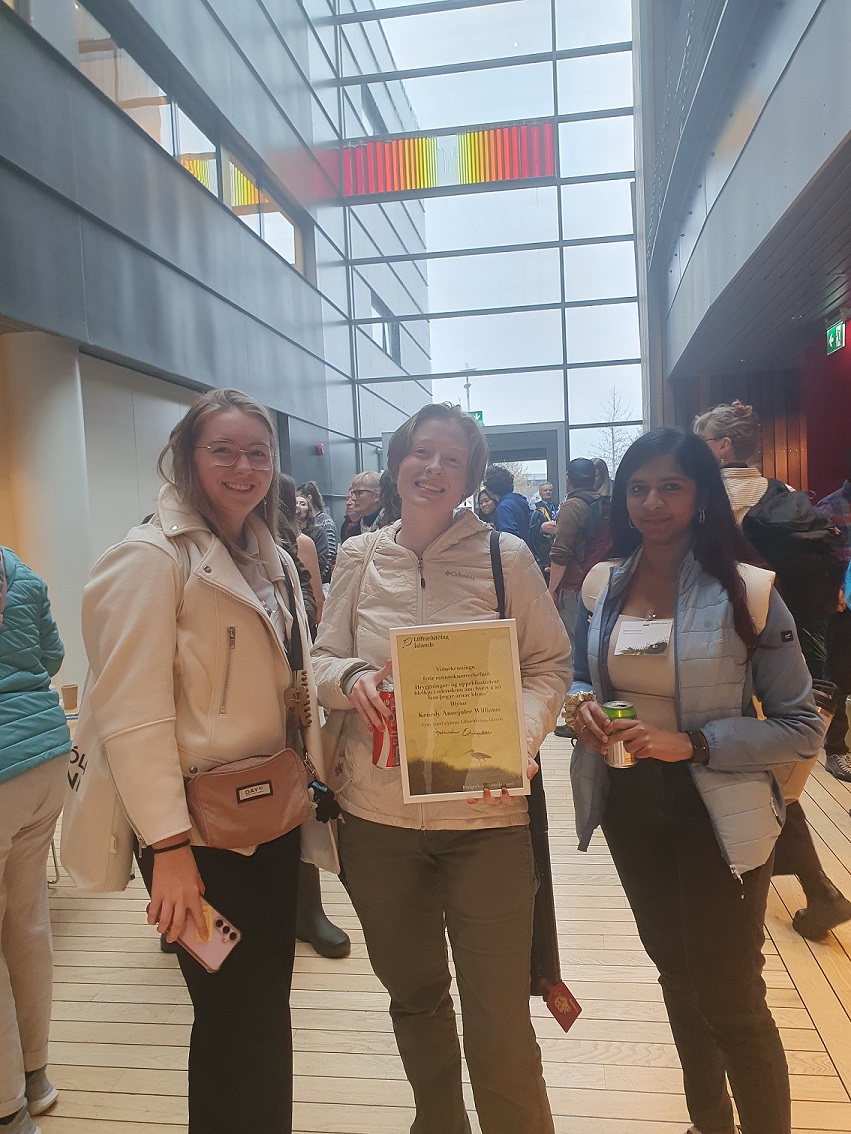
Kenedy Williams presented her poster on the small fish, for which she won the explorer grant. (pictured above in the middle, flanked by Theodóra and Ruhila).

  1. Icelandic Biology conference 2025 (Líffræðiráðstefnan 2025) University of Iceland and decode genetics, 9. - 11. October. Spawning and nursery grounds of Arctic charr in Icelandic rivers: where to go when rivers warm? Kenedy Williams, Johannes Guðbrandsson, Guðbjörg Ósk Jónsdóttir, Ruhila Goswami and Arnar Pálsson.

The talks were the following

  1. Divergence of functional phenotypes in feeding elements of Arctic charr (Salvelinus alpinus) along the benthic – pelagic axis.
    Guðbjörg Ósk Jónsdóttir, Laura-Marie von Elm, Finnur Ingimarsson, Kenedy A. Williams, Ruhila Goswami, Sigurður Sveinn Snorrason, Sarah Elizabeth Steele, Arnar Pálsson
  2. Ecology of hypoponera ants in Icelandic geothermal areas
    Andreas Guðmundsson, Marco Mancini, Arnar Pálsson
  3. The Icelandic ant supercolony. Speculation, possibility or evidence?
    Marco Mancini, Andreas Guðmundsson Gähwiller, Arnar Pálsson
  4. Feeding Element Diversity in Polymorphic Arctic Charr and Monomorphic Brown trout
    Kenedy Annejulee Williams, Ruhila Goswami, Guðbjörg Ósk Jónsdóttir, Ines Eloidin and Arnar Pálsson
  5. Bone specific differences in teeth numbers between two salmonids
    Ruhila Goswami, Kenedy Annejulee Williams, Inés Eloidin, Guðbjörg Ósk Jónsdóttir, Arnar Pálsson
  6. Recent insights from human genetics can illuminate studies of evolution. AP
  7. Erfðafræði, þroskun og líffræði kynbundinna einkenna. AP
Posted in Graduate students, Talks and events

(Icelandic) Fjórðungi bregður til nafns: af uppnefndum genum og sérvisku erfðafræðinga

Sorry, this entry is only available in Icelandic.

Posted in Publications