Category: Organisational

About Defending a Master's thesis

Helmut Neukirchen, 19. June 2016

Note from 2023: the text below is partly outdated. On Ugla, SENS has pretty good info on the timelines and the webforms to be filled out, i.e. ignore the timelines and webforms mentioned below.

The official regulations are in articles 7. and 8. of Regulation no. 994-2017 / Reglur um meistaranám við Verkfræði- og náttúruvísindasvið Háskóla Íslands, nr. 994/2017 (and article 69, items 9-15 of Regulation for the University of Iceland no. 569-2009 / Reglur fyrir Háskóla Íslands Nr. 569/2009. The text below should be in accordance -- if not, it needs to be updated... In charge of MSc. theses at VoN student service is Donna, reachable via the HÍ email user alias sensgraduate.

If you want to graduate, take care that latest in parallel to your Master's project, you finish all your coursework, e.g. Software Engineering students have three mandatory HBV courses. If you are a student coming from non-Computer Science/non-Software Engineering Bachelor, you typically have to take extra courses as part of there admission to the Master's program!

A Master's thesis needs:

  • A supervisor (i. leiðbeinandi): Supervises the student during the whole thesis project.
  • An M.Sc. committee (i. meistaraprófsnefnd) consisting of the supervisor and at least one other person who needs to have an MSc. degree -- typically another university teacher -- (unofficially called "secondary supervisor" (i. meðleiðbeinandi)): Often just gets into the game once the student is almost finished (internally, 10% of the overall supervision efforts assumed, but may be up to 25% and 50%), i.e. has a more or less final draft of the thesis available. Gives comments to improve your draft. So this person should be somewhat familiar with the topic.
  • An external thesis examiner (i. prófdómari): If possible, should be from outside HÍ (in the old days, that person was from the faculty and thus often the old English term "faculty representative" is used. Use in your English thesis the official translation External examiner). That person needs a final draft (release candidate status) before the defense, but must not otherwise be involved in the supervision.

Two web forms needs to be filled out latest 1 week before the defense by the supervisor to book a defense: one for advertising the defense, one for appointing the external examiner (the web forms can be reached via VoN intranet page in UGLA).
There, all the information that are needed (name, title, abstract (for writing an abstract, see also item 4 from Kent Beck), day, supervisors, a photo of the student that will be used for advertising -- but more recently, it seems that the photo is anyway not used, etc.) have to be provided.

To make it for the next graduation ceremony (i. brautskráning) which is in February and June each year (there is till some deadline in October, but no ceremony), there is a deadline (latest 3 weeks before the graduation ceremony for which obviously all the grades need to be handed in). A few days before that deadline, there is typically an event called meistaradagurinn where the idea is that all the students of the faculty defend their thesis. Someone organises this and needs to be contacted to participate. But of course, it is also possible to defend a thesis on another day than on meistaradagurinn.

The schedule of the defense is as follows (meistaradagurinn: typically 45 minutes for talk and discussion, but there is 60 minutes time between defenses to allow time for setting up the presentation):

  • A few introducing words by the supervisor (including an explanation of the procedure).
  • 20-30 minutes presentation of the thesis by the student. No need to be nervous: you know best about your topic and thesis (also, your supervisor would not allow you to defend if you would likely fail)! Learn the introducing words (to get your presentation started fluently) and the concluding words (to avoid an abrupt termination of your talk) by heart.
  • Max. 15 minutes questions from the audience (Note: in practise, 5 minutes for the audience and 10 minutes for internal discussion is best)
  • The audience leaves the room, only the student and the three teachers remain. Now some more private discussion (what was good/bad) and further questions are possible.
  • Finally, the student leaves the room and the teachers discuss the grade (e.g. using a grading scheme) for the thesis and after this, the student is called in again and is told the grade.

Note that the grade is filled into some form that needs to be signed by those involved in grading when using the above web form, this gets prepared by the administration based on the above web form (typically, a PDF of the form is sent to the main supervisor via e-mail by Sigríður Sif Magnúsdóttir a few days before the defense).

Based on the comments that are given during defense, some minor changes to thesis might be required.
Students need to submit an electronic copy of their thesis latest three weeks before (so that you can send the confirmation of submitting before the deadline) the next graduation ceremony (i. brautskráning) to skemman.is (printed version not required anymore, nor is an ISBN number required: remove that line if it is part of your thesis template). Student should also simultaneously need to fill out an declaration of access. The declaration of access template is accessible in English and Icelandic. For commercial settings, access to the thesis can be closed (but not for longer than 4 years); if the thesis is closed, please send the final PDF as well to your supervisors, because they can otherwise neither access it.

If the thesis is accepted, the student will receive an e-mail confirming this. The student must send the confirmation from skemman to sensgraduate at hi.is or to Sigríður Sif Magnúsdóttir by email (before the deadline where all grades for brautskráning need to be available). There is also an UGLA page on brautskráning that hopefully is still available when you read this...

To allow the supervisors to read and comment on the thesis, a first draft needs to be finished in time:

  • First draft for the supervisor: latest 1 month before the defense. Preferably, use an agile approach of delivering early drafts as soon as a new chapter is finished. (Do not start with the Introduction -- that is often the last chapter written.)
  • Release candidate draft for the co-supervisor and "prófdómari" latest 1 week before the defense, better much earlier. This deadline applies also for filling out the above mentioned web form.
  • Poster needs to be printed latest 1 day before defense on Meistaradagurinn (e.g., Háskólaprent does this within 15-30 minutes).

If you finish your thesis in August/September/October you may not need to pay tuition fees for the new academic year.

There is an UGLA page with the various deadlines of the graduation process.

Templates for thesis, presentation, and poster

Note: Since 10/2021, HÍ has a new corporate identity that is covered here:

  • A MS Word template, but I really recommend using the LaTeX templates for writing the thesis. As "Advisors", list first your supervisor and in the next line the secondary/co-supervisors. Note that while the template may contain an ISBN number, you have to remove that line as nowadays, everything is electronic only. Have a look at some older MSc. theses to get an idea of the typical contents.
  • For the defense, a PPT slide template is available on the HÍ corporate design web page -> Hönnunarstaðall (at top right corner) -> Rafrænar einingar ->PowerPoint (and then the download is at the bottom). If you want to rather use LateX for your presentation, Katrín Halldórsdóttir created a LaTeX Beamer template that however is using the old 2010 corporate design (the tex file is GPL, however the logos are property of the University). Any volunteers to update it to the new design?
  • Furthermore, a poster is displayed on Meistaradagurinn (if defense is on a different day, you are still supposed to prepare a poster to be displayed later on Meistaradagurinn). You find templates with the new 2021 look on the HÍ corporate design web page -> Hönnunarstaðall (at top right corner) -> Prentmiðlar -> Veggspjöld (and then the download is at the bottom). However, that template contained in the ppt download is not very helpful -- you rather would need the provided Adobe InDesign template. As most will not have a license for Adobe InDesign, I provide here a PPT template that has been converted from the Adobe InDesign template. Note that you need to download all fonts of the the Google fonttype family "Jost" and install them (if you have it not installed, PowerPoint will use another font, but the printshop that probably has the Jost font and then, the layout does not match anymore).
    I suggest to use a smaller fontsize than in the template: compare with the fontsize used in the PPT template using the old look (but note that the old template uses A0 page size, while the new one uses A4 pages size -- which will then be scaled up when printed in, e.g., A0. Hence, display both side by side for comparison.)
    You should also refer to that old template to get an idea of the typical contents, such as adding the names of the supervisors, etc. As a backup, I provide here a copy of that old template.
    Háskolaprent can print the poster (typically in A0 size).

Note that our School of Engineering and Natural Sciences offers a Course on thesis skills such as writing (and you even get ECTS credit points for it). In addition, you will find on the web other general information on thesis writing.

The 9th System Analysis and Modeling (SAM) conference

Helmut Neukirchen, 1. June 2016

Call for Papers

The System Analysis and Modeling (SAM) conference provides an open arena for participants from academia and industry to present and discuss the most recent innovations, trends, experiences and concerns in modeling, specification and analysis of distributed, communication and real-time systems using ITU-T’s Specification and Description Language (SDL) and Message Sequence Charts (MSC), as well as related system design languages (including but not limited to UML, ASN.1, TTCN, SysML and URN). 

As in previous editions, SAM 2016 will be co-located with the MODELS 2016. The SAM conference originates from the use of languages and techniques for telecommunications applications, whereas MODELS has a background in the application of UML. However, UML is also used for telecommunications, and the languages standardized by ITU-T (ASN.1, SDL-2010, MSC, TTCN-3, URN) are also used for other applications. The MODELS 2016 conference week is a unique opportunity to attend both of these events with overlapping domains of interest.

Scope and Topics

The 2016 edition of the conference is under the theme of Technology-specific aspects of Models. This theme includes domain-specific aspects of models and peculiarities of using models for different technologies, including, but not limited to the Internet of Things (IoT), automotive software, cloud applications, and embedded software. Moreover, we encourage people to consider publishing information about the usage of models for different purposes and the combination with different software engineering technologies, including, but not limited to software testing, requirements engineering, and automated code generation. 

In addition to our theme, we also invite contributions from a broader range of topics from the following non-exhaustive list:

Models and quality:

  • models quality assurance; quality of models and model artefacts; design of reusable models artefacts; reuse of model artefacts; characteristics of model quality.

Language development:

  • domain-specific languages and language extensions; standardization of language profiles; evolution of language standards; modular language design; semantics; evaluation of languages; languages for real-time systems; performance and other non-functional properties.

Model-driven development:

  • systems engineering; analysis and transformation of models; verification and validation of models; simulation; systematic testing based on and applied to models; tool support.

Applications:

  • Using Specification and Description Language, Message Sequence Charts, UML, SysML, ASN.1, TTCN-3, User Requirements Notation, and related languages.
  • Industrial usage reports; experiences from education; domain-specific applicability (e.g., in automotive, aerospace, telecommunication, process automation and healthcare); methodologies for applications.
  • Application reports should focus on what is effective (and ineffective) in applying a technique preferably backed up by some measurements. A report should not just describe an implementation, though new application areas are of interest.

Location and Venue

SAM 2016 will be held in Saint-Malo, France on October 3rd – 4th 2016. The conference will be co-located with the MODELS 2016.

Submission and Publications

All accepted papers will be published in the well-known Springer Lecture Notes on Computer Science. Submissions must be previously unpublished, written in English, and use the LNCS style as described in the LNCS Author and Editor Guidelines. Authors are strongly encouraged to use the LaTeX version of the template. Papers accepted or under review for other events are ineligible for submission to SAM 2016. Submissions in the following categories are solicited:

  • Full papers describing original, unpublished results (max. 16 pages in LNCS style)
  • Short papers describing work in progress (max. 8 pages in LNCS style)

All page limits are including illustrations, bibliography and appendices. Failure to use the LNCS style and comply to the page limit will lead to a desk-reject of the submission.

The SAM 2016 Program Committee will evaluate the technical contributions of each submission as well as its accessibility to the audience. Papers will be judged based on significance, originality, substance, correctness, and clarity.

Information on how to submit your paper can be found on the submission page.

Important Dates

  • Submission of Abstracts: Sunday, June 19th 2016
  • Submission of Papers: Sunday, June 26th 2016
  • Notification: Wednesday July 27th 2016
  • Camera Ready: Friday, August 5th 2016
  • SAM 2016: Monday, October 3rd and Tuesday, October 4th 2016

Requirements for authors

Accepted papers have to be presented by one of the authors at the SAM 2016. A full SAM 2016 conference registration is required for each accepted paper. Failure to comply to these requirements may result in the exclusion of the paper from the proceedings.

Giving external students access to UGLA documents

Helmut Neukirchen, 16. October 2015

Sometimes, students that are not registered for a course (but have an UGLA account), need access to course material in UGLA. This can be achieved as follows:

  1. Operations -> Users and groups
  2. New group
  3. Give the new group some name, e.g. External access. Confirm. (UGLA allows to select registered students to be added here, but leave the group empty!)
  4. On the group overview page click on the newly created group.
  5. Add user
  6. In the SSI/kennitala field: either enter kennitala or the person's full HÍ email address. Save.
  7. All operations -> Change group permission. Change permissions accordingly. NOTE: giving permissions for a folder does not recursively apply to the file contained in the folder -- you need to change each and every individual file as well!
  8. Using the URL that you get from "Front Page" link (or simply via the link provided in the course catalogue), the persons should be able to access the folder.

Alternatively, in the Files and Folder area, you can for individual files and folders change the access permissions using the Edit/pen symbol -> Access Permissions

If you have a person without UGLA account, the only possibility is to make the whole course page world-wide visible:

  1. All Operations -> Change front page title -> At Access to the Teaching Web, select Open for everybody (no authentication)

This and other things (e.g. electronic homework submissing incl. student view of this) is also explained (in Icelandic) at Kennslumiðstöð.

Promotion to full professor: Inaugural lecture

Helmut Neukirchen, 18. November 2014

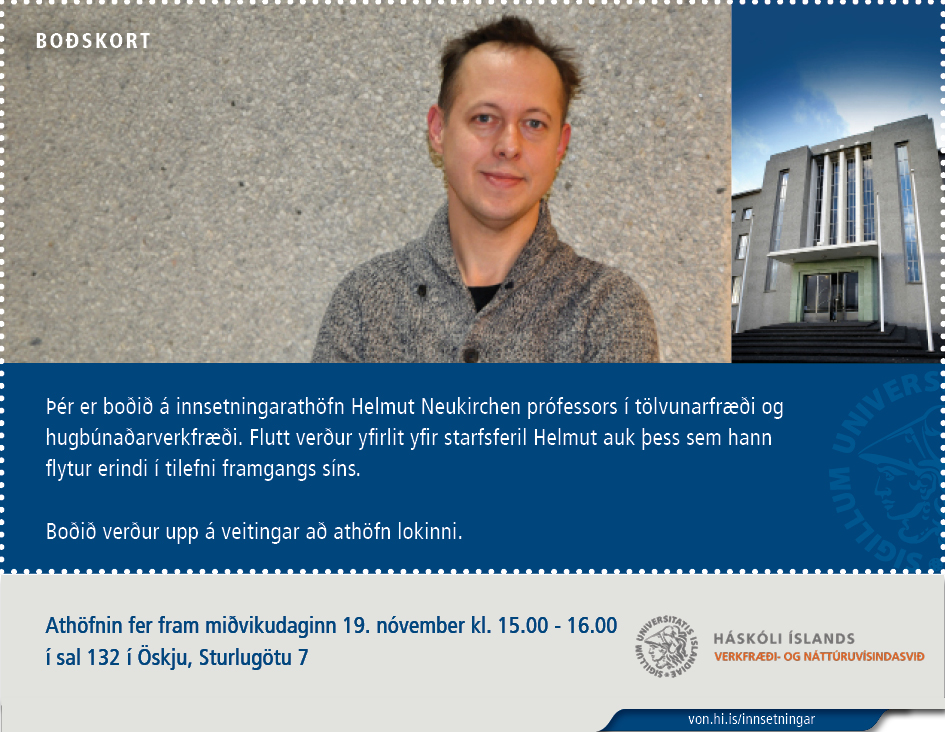
On Wednesday, 19.11.2014, I will celebrate my promotion to full professor. In an inaugural lecture, I will give an overview on my research areas: distributed systems and software engineering. You are welcome to attend in room 132 of building Askja from 15:00 to 15:40. The lecture will be recorded and will later-on be accessible via the School of Enginering and Natural Sciences web page.

bodskort

The lecture was recorded and uploaded to YouTube by someone who is not familiar with German names.

Research semester in autumn 2013, Parental leave in spring 2014, No course on Distributed Systems in autumn 2013

Helmut Neukirchen, 8. August 2013

I will take a research semester in the autumn semester 2013. As a result, the course TÖL102F Distributed Systems will not take place in autumn 2013 as scheduled, but is rather cancelled/postponed.
After the research semester in the autumn semester 2013, I intend to take a 50% parental leave in the spring semester 2014.
During these times, you may not find me in my office, but I will be reachable via e-mail.

Teaching plans for 2012-2014Teaching plans for 2012-2014

Helmut Neukirchen, 7. January 2013

Update from August 2012: Now it is definitive: HBV201F Software Testing is moved from Spring 2013 to Fall 2012 (and therefore called HBV103F). After that it is intended to teach it again every second spring, i.e. next time would be Spring 2015. (Spring 2014 is scheduled for Software Quality Management.)

The planning for my teaching in the academic year 2012/2013 and 2013/2014 is as follows:

Fall 2012

HBV101F Software Maintenance

The course will consist of two parts: The first part is classical lecture-driven to provide some foundations of Software Maintenance. In the second part, we will have a maintenance project where we will do some maintenance of an existing software project: this is mainly homework, but we will have weekly meetings to do some status reporting.

HBV201F Software Testing

(Update: will be taught in Fall 2012!)

Lecture with weekly homework, one of the assignments needs to be presented in front of class.
Will be based on the ISTQB Certified Tester foundation level syllabus. It is the intention to offer an ISTQB Certified Tester exam so that participants can acquire a certification.

Spring 2013

TÖL401G Operating Systems

Lecture with weekly homework that needs to be handed in.

Fall 2013

I will take a research sabbatical, therefor I will not teach at all. Typically, I would teach Distributed Systems in that semester.

Spring 2014

I will be in 50% parential leave in Spring 2014. From the two courses Software Quality Management and Operating Systems that are scheduled to be taught then, I will teach only one (most likely Software Quality Management) and the other (most likely Operating Systems) will be taught by someone else.

Note that courses (non-obligatory only, of course) may get cancelled if not enough participants register in advance: @MSc students take care to register for a course as soon as possible via UGLA!

E-mail is working again

Helmut Neukirchen, 11. January 2012

The e-mail server is working again and no e-mail seem to have been lost.

Truflun á tölvupóstkerfi Malfunction of e-mail server

Helmut Neukirchen, 10. January 2012

The e-mail server at the University of Iceland is experiencing problems. Thus, I can currently not read e-mail. In urgent cases, please phone me (see contact information).The e-mail server at the University of Iceland is experiencing problems. Thus, I can currently not read e-mail. In urgent cases, please phone me (see contact information).

In parental leave in 2010

Helmut Neukirchen, 1. January 2010

Helmut Neukirchen is in parental leave ("fæðingarorlof") from January to December 2010. While I will be reading e-mail during that time, you will find me rarely in my office. However, you can meet me by arranging an appointment via e-mail.