Category: Teaching

Open professor position in Computer Science or Software Engineering

Helmut Neukirchen, 25. September 2026

The University of Iceland invites applications for a full-time position as Assistant Professor in computer science or software engineering within the Department of Computer Science in the School of Engineering and Natural Sciences. In accordance with the University of Iceland's regulations, the duties of academic staff are divided into three main areas: research, teaching, and administration.

Field of work

  • Teaching within the department, including introductory courses
  • Supervision of master's and doctoral students
  • Conducting research in computer science, software engineering or related fields
  • Attracting domestic and international research funding
  • Participation in the administration of the department and teaching development

Qualification requirements

  • Ph.D. in computer science, software engineering or a closely related field
  • An active research record with publications in international venues in the field of computer science or software engineering
  • Good command of English, both written and spoken
  • Experience in university teaching and student supervision is an advantage
  • Experience in attracting research funding is an advantage
  • Experience in interdisciplinary collaboration and/or of collaboration with industry is an advantage
  • Good collaborative and interpersonal skills, with the ability to communicate knowledge effectively
  • The ability to teach in Icelandic is an advantage. Appointees are required to attain proficiency at the B1 level in Icelandic within four years of appointment. The University of Iceland provides support to help staff achieve the necessary language skills.

Applications are particularly encouraged from candidates working in one or more of the following areas, although applications from other areas of computer science are also welcome:

  • Human-computer interaction. User-centred software engineering, requirements engineering, user experience and interaction design, accessible and inclusive design, together with qualitative and quantitative methods for user research.
  • Applied artificial intelligence. Software development supported by generative AI, based on formal and informal specifications; verification and validation of AI-generated code; together with the design, orchestration and evaluation of AI agents that carry out tasks with limited supervision.
  • Cyber-physical systems. Embedded systems, edge computing, robotics, and distributed or resource-constrained systems.
  • Cybersecurity. Security and resilience of software, systems and networks; cryptography and secure protocols; vulnerability analysis; monitoring of and response to security incidents; together with the human dimensions of cybersecurity.

Application process

The position will be filled for a term of five years, with the possibility of a permanent appointment thereafter, cf. Paragraph 3, Article 31 of the Rules of the University of Iceland No. 569/2009. Applicants who meet the relevant requirements may apply for expedited promotion immediately following recruitment under Article 3 of Regulation no. 1300/2020 on promotion of academic staff at the University of Iceland.
The processing of applications, evaluation of candidates` qualifications, and appointment to the position shall follow the provisions of Act No. 85/2008 on Public Universities and the Rules of the University of Iceland No. 569/2009.

Applicants must submit the following documents with their application:

  1. A cover letter outlining, among other things, how the applicant meets the qualification requirements
  2. Diploma(s) or, where applicable, a certificate of academic record
  3. Academic curriculum vitae (CV)
  4. List of publications
  5. A report on research work and other professional work undertaken
  6. A statement of research and teaching plans if appointed
  7. Information on potential referees who may be contacted

The application must indicate which of the applicant`s publications, up to eight in total, are considered most significant with regard to the position in question. Applicants should submit only these publications with their application or provide information on where they are electronically accessible. If a submitted work has multiple authors, applicants must clarify their individual contribution to the work. Application materials that cannot be submitted electronically should be sent in two copies to the Science and Innovation Department, University of Iceland, Sæmundargata 2, 101 Reykjavík.

All applications will be answered, and applicants will be informed of the outcome once a decision has been made. Applications may remain valid for six months after the application deadline.

In hiring for positions at the University of Iceland, the University`s equality policy is taken into account. Attention is also drawn to the University of Iceland`s language policy.

Since 1911, the University of Iceland has been a leading institution for business and societal progress in Iceland. It is a forward-looking research university and an active participant in international scientific collaboration.

The University of Iceland is the largest university in the country, offering nearly 400 programs at the undergraduate, master`s, and doctoral levels. Approximately 14,000 students are enrolled, including over 2,000 international students.

More than 1,800 staff members work at the University of Iceland. The university emphasizes attracting a diverse community of employees and students to an international academic environment, where academic freedom, professionalism, equality, diversity, and inclusion are prioritized.

Application deadline

Application deadline is 02.10.2026, 23:59 UTC+0.

For further information contact

Kristján Jónasson

jonasson@hi.is

Hafsteinn Einarsson

hafsteinne@hi.is

Online application form Note: you can switch to English and while it offers you to sign in with an Icelandic Id number or even electronic Id, non-Icelandic residents can also simply register a new user.


Open for applications in our Computer Science, Software Engineering and Computational Engineering programmes / Opið fyrir umsóknir: Tölvunarfræði, Hugbúnaðarverkfræði, Reikniverkfræði

Helmut Neukirchen, 4. March 2026

The deadlines for applying for our Computer Science, Software Engineering and Computational Engineering programmes are as follows:

As I was involved in updating our programmes, I can assure you that you will receive up-to-date education and can really recommend studying with us.

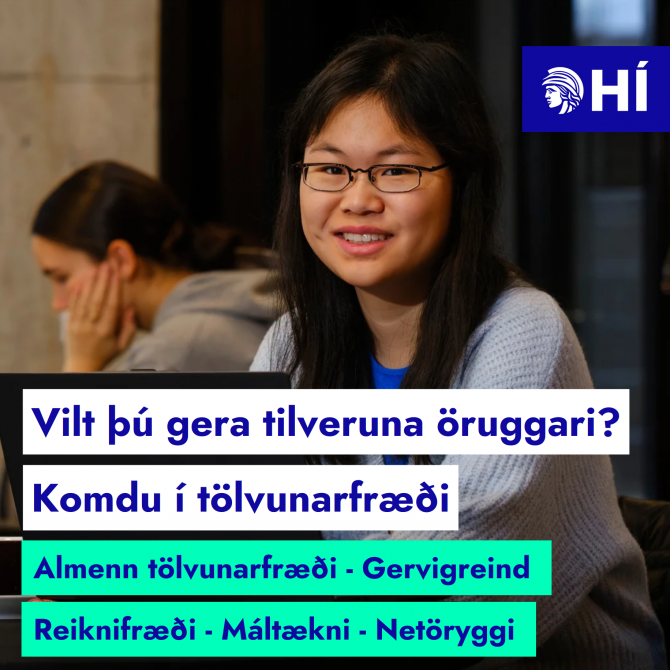
It was in the news that Iceland will need 9000 specialists within next 5 years -- you will be one of them if you studied at University of Iceland. While due to the advent of AI, it is often said that only senior programmers are needed, but not junior programmers anymore -- but where should senior programmers come from if they were not junior programmers before? Also, someone needs to develop the AI models: this is exactly what you learn at University of Iceland where you can take course on AI, including a specialisation in Artifical Intelligence/Machine Learning (Gervigreind).

Our B.Sc. study programmes are: B.Sc. in Computer Science/Tölvunarfræði and B.Sc. in Software Engineering/Hugbúnaðarverkfræði.
In Computer Science, we have additional specialisations in AI/Machine Learning (Gervigreind) and Computational Science (Reiknifræði).

Our M.Sc. study programmes are: M.Sc. in Computer Science/Tölvunarfræði, M.Sc. in Software Engineering/Hugbúnaðarverkfræði, and M.Sc. in Computational Engineering.
We have additional specialisations in Cybersecurity (Netöryggi), Language Technology (Máltækni) and Innovation (Nýsköpun og viðskiptaþróun -- the Innovation courses are taught in Icelandic).

If you want to learn more about Software Engineering, I have a blog post Why you should study Software Engineering / Af hverju hugbúnaðarverkfræði and a distinction of Software Engineering versus Programming.

Information meeting on the courses of the joint cybersecurity master's programme

Helmut Neukirchen, 11. January 2026

On Monday, 12.1.2026, 16:00, room Ada (Computer Science department, 3rd floor of building Gróska), there will be an information meeting on the joint cybersecurity master's programme and cysec courses being offered at University of Iceland and Reykjavik University. The cybersecurity courses can also be taken by students who are not enrolled in the cybersecurity specialization. Everyone is welcome to attend!

You can find more info here: https://uni.hi.is/helmut/cybersecurity/ -- including the presented slides will.


This joint cybersecurity master's programme would not be possible without funding from the University Collaboration Fund of the Ministry of Higher Education, Science and Innovation and co-funding from the ECCC/EU for the projects ICEDEF – Defend Iceland and Eyvör – the National Cybersecurity Coordination Centre of Iceland (NCC-IS).


Do AI coding assistants increase or decrease productivity?

Helmut Neukirchen, 9. September 2025

While I am teaching to use AI coding assistants (and emphasize the pros and cons, in particular that it helps only if you have enough knowledge to judge whether the output is correct or pure hallucination), there have been recently two studies published that give an indication that AI coding assistants do actually decrease productivity:

One aspect is that developers learn over time about the project that they are working on whereas LLMs have been trained once and will always start from scratch in a project where they are used as coding assistants.

A personal idea for future research: as there have been reports about AI slob (e.g. AI generates low-quality documents that get distributed and then take time to read and therefore, this reduces in the end productivity), it might be worthwhile to measure the impact of AI coding assistants on maintainability: if AI coding assistance would produce code that is hard to maintain, then any gains by AI coding assistants might get eaten up in future when it comes to maintenance.

Cybersecurity at the 21st Icelandic HPC Community Workshop

Helmut Neukirchen, 29. August 2025

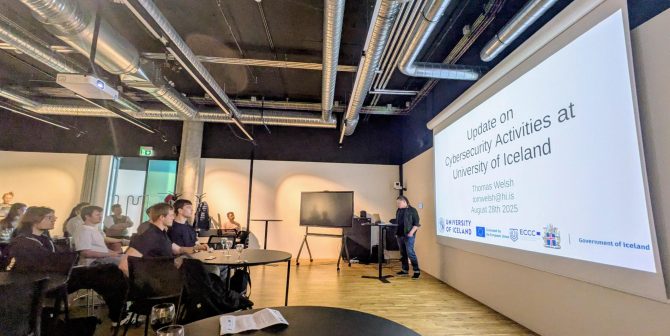
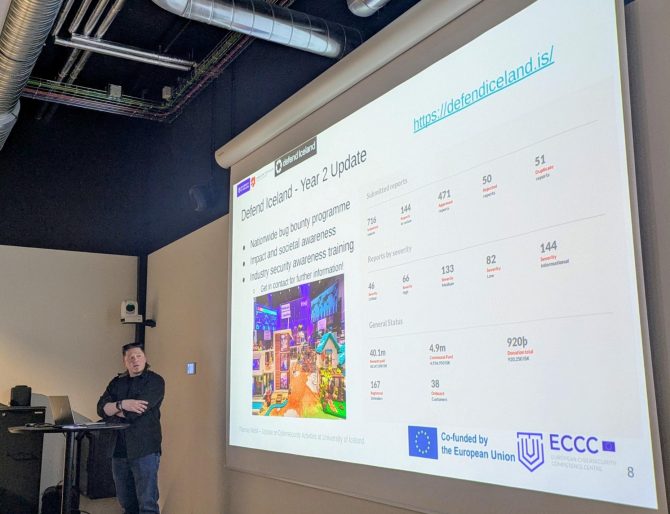
We presented an update on our cybersecurity activities to industry and students at the 21st Icelandic HPC Community Workshop August 28, 2025.

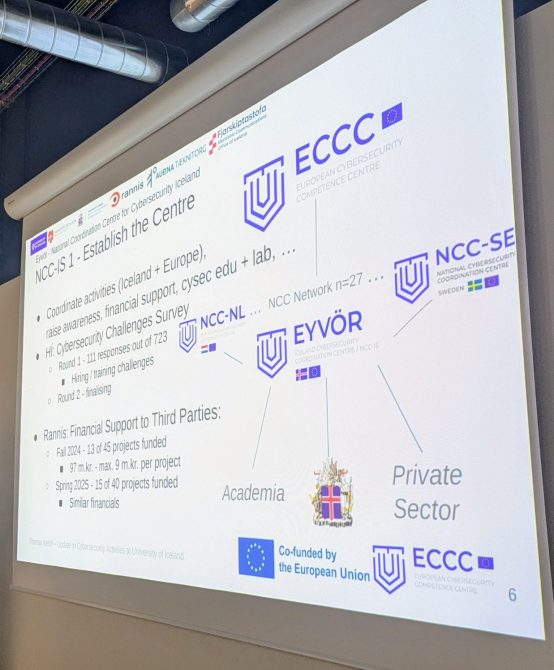
We covered there the joint MSc. programme in cybersecurity, our research, and the Digital Europe Programme projects Eyvör NCC-IS, the National Coordination Centre for Cybersecurity in Iceland and Defend Iceland, including the European network of NCCs and the European Cybersecurity Competence Centre (ECCC).


This event is in the context of our cybersecurity activities and the ECCC/EU co-funded projects ICEDEF – Defend Iceland and Eyvör – the National Cybersecurity Coordination Centre of Iceland (NCC-IS).


Children's university visiting Computer Science department

Helmut Neukirchen, 12. June 2025

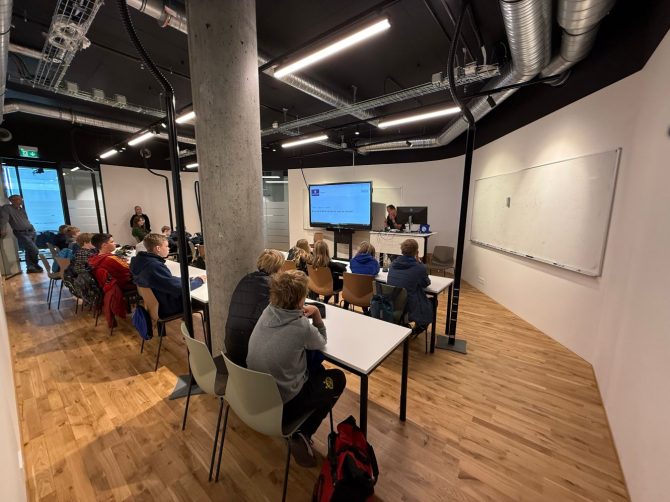
On 11th of July 2025, participants of the Children's university (Háskóli unga fólksins) visited the Computer Science department. We did there a mini tabletop exercise on critical infrastructure in Iceland and after that authentication was discussed, e.g.:

  • use different passwords for different services -- do not use the same password everywhere (if your password got stolen, it will by tried at all kinds of other web pages, so if you use the same password everywhere, all other services can be accessed using your identity,
  • use two factor authentication: even if your password got stolen, an attacker would still need the second authentication factor, e.g., would need to steal your phone that contains some authentication app as second factor in addition to your password.


This event is in the context of our cybersecurity activities and the ECCC/EU co-funded projects ICEDEF – Defend Iceland and Eyvör – the National Cybersecurity Coordination Centre of Iceland (NCC-IS).


Application deadline for M.Sc. studies passed -- but you can still apply for B.Sc. studies and change from there into M.Sc. / Búinn/Búin að missa umsóknarfrest í mastersnám?

Helmut Neukirchen, 16. April 2025

While the deadline for our M.Sc. programmes in Tölvunarfræði/Computer Science, Hugbúnaðarverkfræði/Software Engineering, and Reikniverkfræði/Computational Engineering have passed, you can still enroll into or B.Sc. programmes.

Software Engineering

Computer Science

So, if you wanted to enroll into one of our M.Sc. programmes, but missed the deadlines: just enroll into a related B.Sc. programme (e.g. Iðnaðarverkfræði/Industrial Engineering) which allows you to take courses, including the M.Sc. courses of the M.Sc. programme that you were aiming for. In some cases, you need to talk to the teachers of these courses to get admitted as a non-B.Sc. student (but this should not be a problem if you can show that you have already the B.Sc. degree that is assumed for that course). You can then still change next year into your desired M.Sc. programmes and get your M.Sc. courses that you already took accounted.

Research trip/Vísindaferð to the Computer Science department

Helmut Neukirchen, 28. March 2025

Research trip/Vísindaferð is a visit to learn about companies (also as future employers) and to learn about the science behind the products that they develop. Often, these are organised by student associations as a social event.

This time, our student association Nörd visited not a company, but their teachers at the Computer Science department to learn about the research done there -- to get an idea of topics that they could do later as M.Sc. students.

I presented the following short slide deck on Software Engineering research area and the Cybersecurity M.Sc. specialisations.

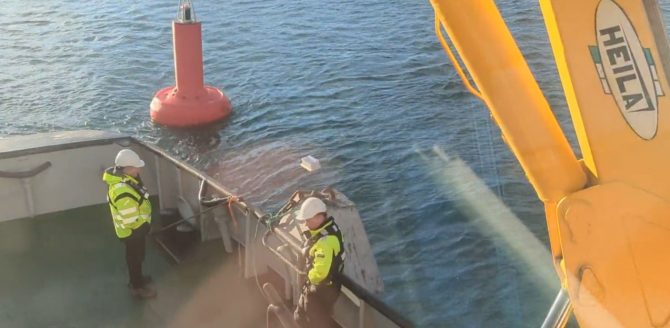
The above video shows the results of the M.Sc. thesis Design and Implementation of a Buoy Positioning and Monitoring System Using Differential GNSS and LoRaWAN.

Open for applications in our B.Sc. programmes

Helmut Neukirchen, 5. March 2025

The deadline (for students from Iceland) for applying for our B.Sc. programmes in Computer Science and Software Engineering is 5. June for the autumn semester that starts end of August. As I was involved in updating our programmes, I can assure you that you will receive up-to-date education and can really recommend studying with us.

It was just recently in the news that Iceland will need 9000 specialists within next 5 years -- you will be one of them if you studied Computer Science and Software Engineering at University of Iceland.

If you want to learn more about Software Engineering, I have a blog post Why you should study Software Engineering / Af hverju hugbúnaðarverkfræði and a distinction of Software Engineering versus Programming.

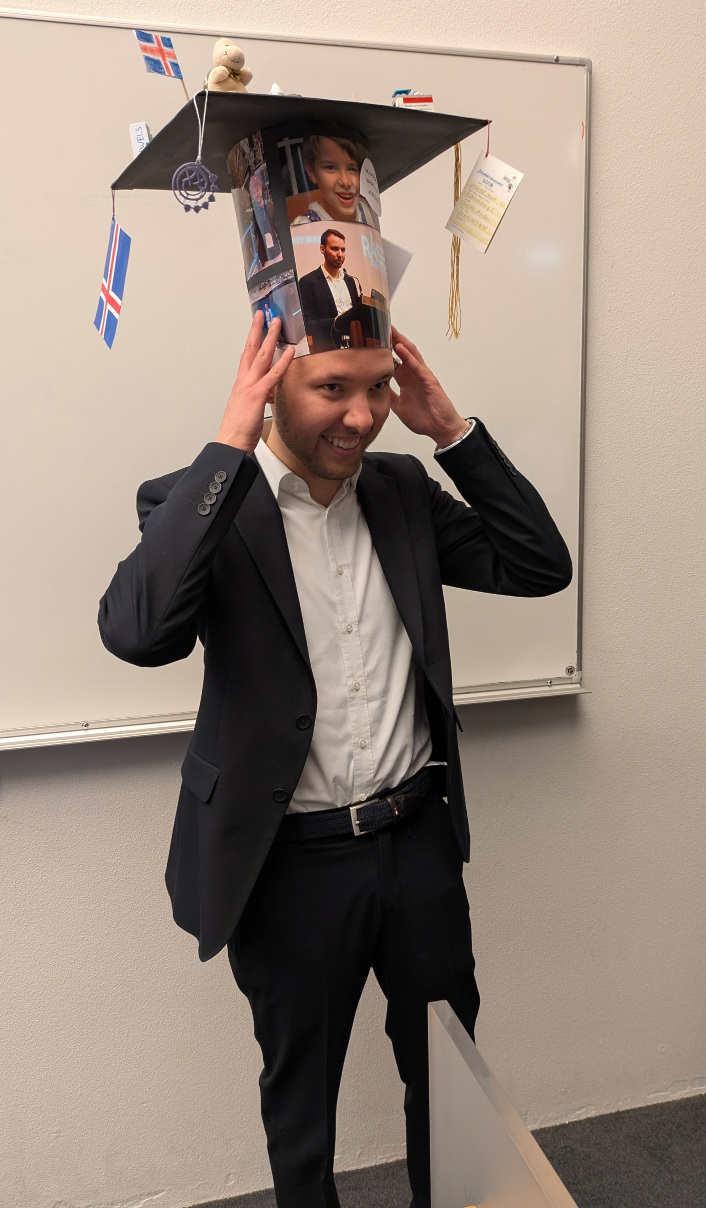
Successful PhD defense by Marcel Aach

Helmut Neukirchen, 30. January 2025

Marcel Aach defended yesterday successfully his PhD thesis on Parallel and Scalable Hyperparameter Optimization for Distributed Deep Learning Methods on High-Performance Computing Systems.

Marcel's research was rooted in the CoE RAISE project. This PhD is an example of the collaboration between the Faculty of Industrial Engineering, Mechanical Engineering and Computer Science and Jülich Supercomputing Centre (JSC).